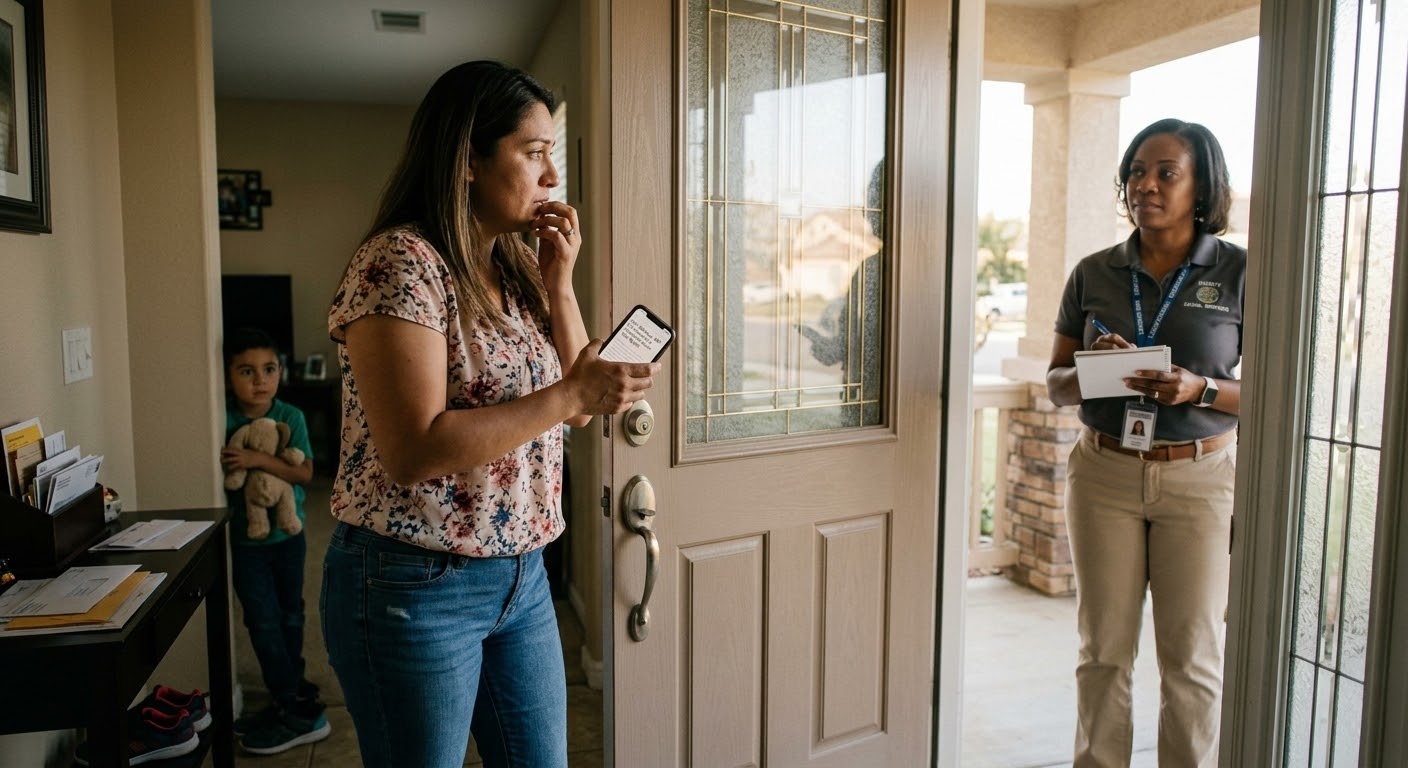
A CPS social worker just called and wants to come to your home. Or maybe they showed up unannounced at your door. You are wondering: do I have to let them in? What happens if I say no? What are my rights? These are exactly the right questions to ask — and the answers matter enormously for what happens next.
The Short Answer: It Depends on the Situation
California law does not give CPS an automatic right to enter your home. Whether you can refuse a CPS home visit depends on a few key factors: whether they have a court order, whether there is an emergency safety situation, and what stage the investigation is in.
This is one of the most important distinctions parents need to understand. Getting it wrong in either direction — refusing a visit you are legally required to allow, or letting workers in when you have the right to decline — can have serious consequences for your case.
The Most Important Thing You Can Do Before Deciding Before you respond to any CPS request for a home visit — whether by phone or at your door — call an attorney. Even a brief conversation with an experienced dependency attorney can help you understand exactly what you are and are not required to do in your specific situation. Family First Attorneys is available 24/7 at (468) 777-7777.
When CPS Cannot Enter Your Home Without Permission
Under the Fourth Amendment of the United States Constitution and Article I, Section 13 of the California Constitution, you have the right to be free from unreasonable searches and seizures. This protection applies to your home, which means CPS cannot simply walk in without your consent.
If a CPS social worker knocks on your door and asks to come in, you are generally within your rights to:
- Decline to let them inside
- Ask them to schedule a visit for another time when your attorney can be present
- Speak with them through a closed door or outside without inviting them in
- Ask them to provide their name, employee ID number, and supervisor’s name
- Request that any interview be conducted with your attorney present
Simply declining a home visit is not an admission of guilt and, by itself, cannot be used as direct evidence against you. However, it is important to understand that refusing a visit is not without consequences — it may prompt CPS to seek a court order, which gives them the legal authority to enter.
When CPS Can Enter Your Home Without Your Permission
There are specific situations where CPS does have the legal authority to enter your home even without your consent. Understanding these exceptions is critical.
1. Emergency Situations
If CPS believes a child is in immediate danger — meaning there is an emergency that requires immediate action to prevent serious bodily injury or death — they may enter your home without a warrant or court order. This is known as the “emergency exception” to the warrant requirement.
However, the emergency must be genuine and immediate. CPS cannot simply claim an emergency to get around the warrant requirement. If you believe CPS entered your home improperly by claiming a false emergency, your attorney may be able to challenge the removal or any evidence gathered during that visit.
2. A Court Order or Search Warrant
If CPS has obtained a court order or search warrant authorizing entry into your home, you are legally required to allow them in. Refusing entry when CPS has a valid court order can result in law enforcement being called to assist with entry and can seriously damage your standing in the dependency case.
If CPS shows up claiming to have a court order, ask to see it. You have the right to review the document before allowing entry. Look for the judge’s signature, the date, and the specific address listed. If anything seems unclear, call your attorney immediately — even while CPS is at the door.
3. Consent From Any Adult in the Home
If another adult in your home — a spouse, partner, roommate, or even an older teenager — voluntarily invites CPS workers inside, CPS may be able to enter based on that person’s consent, even if you did not agree. If you do not want CPS entering your home, make sure everyone in the household understands your position before a visit occurs.
When CPS Comes to Your Door: Do’s and Don’ts
✅ YOU CAN DO THIS — ❌ DO NOT DO THIS
Ask for the worker’s name, ID number, and supervisor | Do not invite them inside without speaking to an attorney first Ask if they have a court order or search warrant | Do not argue, yell, or become confrontational Step outside and speak with them at the door | Do not make statements about the allegations without legal advice Call an attorney before answering detailed questions | Do not sign any documents without attorney review Be calm and polite in all interactions | Do not allow other adults in the home to consent on your behalf Ask what specific allegations they are investigating | Do not ignore them entirely without explaining you are seeking counsel Request that any interview be scheduled with your attorney present | Do not post about the interaction on social media
What Happens If I Refuse and CPS Gets a Court Order?
If you decline a home visit and CPS believes the investigation warrants it, they can go to a judge and request a court order authorizing entry. In California, judges take child welfare allegations seriously and will often grant these orders if CPS presents even basic justification.
Once a court order is in place, refusing entry is no longer an option — and attempting to do so can result in law enforcement accompanying the social workers to your home. More importantly, a refusal pattern can be used by CPS to argue that you are uncooperative, which can hurt your case.
This is why the goal is not simply to refuse and wait for a court order. The goal is to give yourself time to get legal representation so that when the visit does occur, you are protected, prepared, and not navigating the encounter alone.
CPS Interviews of Your Children at School
One of the most alarming situations parents face is learning that a CPS worker interviewed their child at school without notifying them first. Many parents assume this cannot happen. In California, it can.
Under California Welfare and Institutions Code Section 628.1, CPS social workers are permitted to interview children at school without first notifying the parents, particularly when the allegations involve abuse by a parent or guardian. The school is required to allow this access.
However, there are limits. The child has the right to have a support person present during the interview if they request one. And if the interview is conducted improperly or the child was pressured or coached, your attorney may be able to challenge the value of that interview as evidence in court.
If you learn that CPS interviewed your child at school, document everything you know about the encounter and contact your attorney immediately.
The Real Risk of Refusing Without Legal Guidance
Here is the reality that experienced dependency attorneys see regularly: parents who refuse CPS visits without understanding the legal context often make their situations significantly worse. Refusal without legal guidance can:
- Prompt CPS to accelerate their investigation and seek emergency removal orders
- Be cited as evidence of non-cooperation in court documents
- Lead to a court order that gives CPS broader access than a voluntary visit would have
- Result in law enforcement involvement that escalates an already tense situation
On the other hand, parents who have an attorney advising them from the first contact with CPS are in a much stronger position. Their attorney can negotiate the terms of home visits, ensure a legal representative is present, prepare the parent for what to say, and limit the damage that even a well-meaning but legally naïve parent might cause by talking too freely.
If CPS Has Already Contacted You — Act Now
The moment CPS contacts you about a home visit or investigation is the moment to call an attorney — not after the visit, not after the Detention Hearing, and not after documents have been signed. Pre-investigation legal counsel is one of the most effective tools available to parents facing CPS involvement.
At Family First Attorneys, we represent parents at every stage of the dependency process — including before a formal case is ever opened. We can advise you on how to respond to CPS contact, whether and how to allow a home visit, and how to protect your rights from the very first interaction.
Our goal is always to help families stay together — and the best time to start building your defense is before CPS has gathered evidence against you.
Get Legal Guidance Before the Home Visit Call Family First Attorneys now: (468) 777-7777 Available 24 hours a day, 7 days a week for emergency consultations. Serving Orange County, Los Angeles County, Riverside County, and San Bernardino County. Free initial consultation. Se habla español.
- What to Do in the First 24 Hours After DCFS Takes Your Child
This article is for informational purposes only and does not constitute legal advice. No attorney-client relationship is formed by reading this content. California law regarding CPS investigations is complex and the appropriate response to a home visit depends on the specific facts and circumstances of your situation. Please consult a qualified California dependency attorney before taking any action related to a CPS investigation.
Protect Your Family — Call Now
Family First Attorneys provides 24/7 emergency consultations and aggressive defense for parents across Los Angeles, Orange, Riverside, and San Bernardino Counties.
Call (468) 777-7777 — Free ConsultationThis article is for informational purposes only and does not constitute legal advice. No attorney-client relationship is formed by reading this content. Every CPS and DCFS case is unique and the outcome depends on the specific facts and circumstances involved. Please consult a qualified California family law attorney regarding your specific situation.