If you are reading this, you are likely facing one of the most terrifying moments a parent can experience. The thought of losing custody of your children, whether through a contentious divorce or an unexpected knock on the door from Child Protective Services (CPS), can leave you feeling paralyzed with fear and confusion. You might be wondering what happens next, who will make decisions about your family, and where those decisions will be made. Navigating the legal system is daunting enough, but when your children are involved, the stakes are unimaginably high.
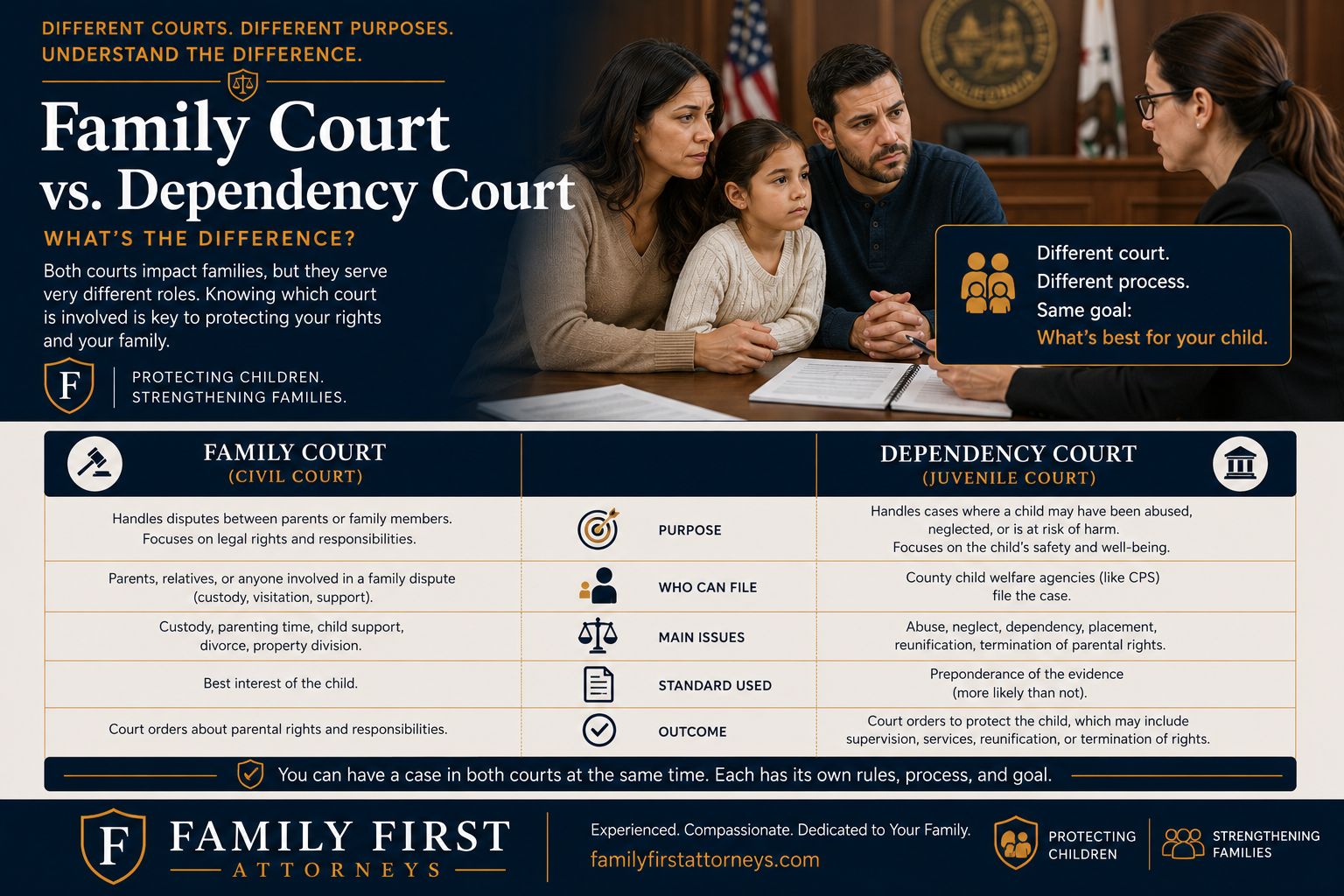
One of the most common sources of confusion for parents in crisis is understanding the difference between family court and juvenile dependency court. While both courts handle matters related to children and parenting, they operate under entirely different rules, procedures, and objectives. Knowing which court you are dealing with—and what to expect—is the first critical step in protecting your family.
In this comprehensive guide, we will break down the key differences between these two legal arenas, explain how CPS involvement changes the landscape, and provide actionable advice to help you navigate this challenging time.
What Is the Main Difference Between Family Law and Juvenile Dependency?
At its core, the difference between family law and juvenile dependency comes down to who is initiating the legal action and why.
Family Court is designed to resolve disputes between private parties. If you are going through a divorce, separating from your child's other parent, or seeking to establish paternity, you will find yourself in family court. Here, the judge makes decisions about child custody, visitation schedules, child support, and the division of assets. The state is not a party to the case; it merely provides the forum (the court) for you and the other parent to resolve your disagreements. The primary focus is on determining what custody arrangement is in the "best interest of the child" based on the evidence presented by both parents.
Juvenile Dependency Court, on the other hand, is a specialized court that steps in when the government believes a child is not safe. If CPS (often referred to as the Department of Children and Family Services, or DCFS, in many California counties) receives a report of child abuse, neglect, or abandonment, they will investigate. If they determine the child is at risk, the state—acting through the county's child welfare agency—files a petition against the parents. In dependency court, the dispute is not between two parents; it is between the parents and the government. The court's primary objective is to protect the child, which can result in the child being removed from your home and placed in foster care or with a relative.
Understanding this fundamental difference is crucial because the strategies used to win a family court case are vastly different from those needed to successfully defend against CPS in dependency court.
Which Court Handles CPS Cases?
If CPS or DCFS becomes involved with your family and decides to take legal action, your case will be heard in Juvenile Dependency Court.
When CPS removes a child from a home or files a petition alleging that a child is at risk, they are operating under the authority of the California Welfare and Institutions Code (WIC). Specifically, WIC Section 300 outlines the various circumstances under which a child can be declared a dependent of the court. These include physical abuse, severe emotional damage, sexual abuse, or the failure of a parent to provide adequate food, clothing, shelter, or medical care.
If a WIC 300 petition is filed, the dependency court takes jurisdiction over your child. This means the juvenile court judge now has the ultimate authority to make decisions about where your child lives, who they can visit, and what services you must complete to get them back.
It is important to note that if you already have an existing custody order from family court, a juvenile dependency case will override it. The dependency court's orders take precedence because the state's interest in protecting a child from harm supersedes a private custody dispute.
How Do the Legal Procedures Compare in Family Court vs Dependency Court?
The procedures in family court vs dependency court are drastically different, and understanding these differences can help you prepare for what lies ahead.
Who Are the Parties Involved?
In family court, the parties are typically the two parents. You each have the right to hire your own attorney, but the court will not appoint one for you if you cannot afford it.
In dependency court, the parties include the parents, the child welfare agency (represented by county counsel), and the child. Because fundamental constitutional rights are at stake—specifically, your right to parent your child—the court will appoint an attorney for you if you cannot afford one. The child will also be appointed their own attorney to represent their interests.
What Is the Burden of Proof?
In family court, decisions are generally made based on a "preponderance of the evidence." This means the judge will decide which parent's proposed custody arrangement is more likely than not in the child's best interest.
In dependency court, the stakes are higher. To remove a child from your care, the state must prove by "clear and convincing evidence" that there is a substantial danger to the child's physical or emotional health and that there are no reasonable means to protect the child without removal. This is a higher legal standard, reflecting the severity of state intervention in family life.
Are the Hearings Public or Confidential?
Family court proceedings are generally open to the public. Anyone can walk into the courtroom and observe the hearings, and the court files are typically public records.
Juvenile dependency court proceedings are strictly confidential. Because these cases involve sensitive allegations of abuse and neglect, the hearings are closed to the public. Only the parties involved, their attorneys, and specific individuals authorized by the judge are allowed in the courtroom. The court files are also sealed to protect the privacy of the child and the family.
What Should You Do If You Are Facing a Dependency Court Case?
If you find yourself facing a juvenile dependency case, the actions you take in the first few days and weeks are critical. Here is some practical, actionable advice to help you protect your rights and your family:
- Do Not Ignore the Situation: A CPS investigation will not simply go away if you ignore it. Failing to appear at a dependency hearing or refusing to cooperate with court orders can result in the permanent loss of your parental rights.
- Be Careful What You Say: Anything you say to a CPS social worker can and will be used against you in court. While you should be polite, you are not obligated to answer their questions without an attorney present. Do not admit to any wrongdoing or make statements out of anger or fear.
- Follow the Case Plan: If the court orders you to complete certain services—such as parenting classes, drug testing, or counseling—do it. Your willingness to comply with the court's orders is the most important factor in getting your children back.
- Gather Evidence: Start collecting evidence that demonstrates your ability to provide a safe and loving home. This could include medical records, school reports, character references, and proof of stable housing and employment.
- Hire Experienced Legal Representation: Dependency court is a highly specialized area of law. A family law attorney who only handles divorces may not know the intricacies of the Welfare and Institutions Code. You need an attorney who specifically understands how to fight CPS and navigate the dependency system.
Can a Family Court Case Turn Into a Dependency Court Case?
Yes, it is entirely possible for a family court case to transition into a dependency court case. This often happens during highly contentious custody battles. If one parent makes allegations of abuse or neglect against the other parent in family court, the family court judge is mandated by law to report those allegations to CPS.
Once CPS receives the report, they will launch an investigation. If they find the allegations to be credible and determine the child is at risk, they may file a petition in juvenile dependency court. At that point, the family court case is essentially put on hold, and the dependency court takes over.
Unfortunately, it is not uncommon for parents to make false allegations of abuse in an attempt to gain an advantage in a custody dispute. If you are falsely accused, it is imperative that you defend yourself aggressively in both family and dependency court to prevent the loss of your custody rights.
Frequently Asked Questions
What happens if I already have a custody order from family court, but CPS gets involved?
If CPS files a petition in juvenile dependency court, the dependency court takes jurisdiction over your child. Any existing family court custody orders are temporarily suspended. The dependency judge will make all decisions regarding custody and visitation until the dependency case is closed. Once the dependency case concludes, the judge may issue "exit orders" that become the new family court custody orders.
Will I get a court-appointed attorney in family court?
No. In family court, you are responsible for hiring and paying for your own attorney. If you cannot afford one, you will have to represent yourself (act as a "pro per" litigant). However, in juvenile dependency court, you have a constitutional right to legal representation, and the court will appoint an attorney for you if you cannot afford one.
How long does a juvenile dependency case last?
The timeline for a dependency case varies widely depending on the circumstances. By law, parents of children under the age of three are typically given six months to complete their case plan and reunify with their child. Parents of older children are usually given 12 months. However, these timelines can be extended up to 18 or even 24 months in certain situations. If reunification fails, the case can end in the termination of parental rights and adoption.
Can I use the same lawyer for both family court and dependency court?
While you can use the same lawyer, it is crucial to ensure that your attorney has extensive experience in both areas of law. Many family law attorneys do not practice in dependency court because the rules and procedures are so different. You need an attorney who is well-versed in both family court vs dependency court dynamics.
What is a WIC 300 petition?
A WIC 300 petition is the formal legal document filed by the county child welfare agency (CPS/DCFS) to initiate a juvenile dependency case. It outlines the specific allegations of abuse or neglect under Section 300 of the California Welfare and Institutions Code and asks the court to declare the child a dependent of the state.
Can I appeal a decision made in dependency court?
Yes, you have the right to appeal certain decisions made by a juvenile dependency judge. However, the appeals process is complex and subject to strict deadlines. If you disagree with a court ruling, you should consult with your attorney immediately to discuss your options for filing an appeal or a writ petition.
Protect Your Family with Experienced Legal Counsel
When your children are on the line, you cannot afford to take chances. Whether you are navigating a complex custody dispute in family court or fighting to keep your children out of the foster care system in juvenile dependency court, the legal system is unforgiving to those who are unprepared.
At Family First Attorneys, located in Orange, California, Managing Attorney Mitchell Krems and our dedicated team understand the fear and uncertainty you are facing. We specialize in both CPS/DCFS defense and complex family law matters. We know the tactics the government uses to separate families, and we know how to fight back.
You do not have to face this nightmare alone. We will stand by your side, protect your rights, and fight tirelessly to keep your family together. If you are dealing with CPS involvement or a difficult family law case, contact Family First Attorneys today to schedule a confidential consultation. Let us help you take the first step toward bringing your children home.
Protect Your Family — Call Now
If CPS or DCFS is involved with your family, don't wait. Family First Attorneys provides 24/7 emergency consultations and aggressive defense for parents across Los Angeles, Orange, Riverside, and San Bernardino Counties.
Call (468) 777-7777 — Free ConsultationThis article is for informational purposes only and does not constitute legal advice. No attorney-client relationship is formed by reading this content. Every CPS and DCFS case is unique and the outcome depends on the specific facts and circumstances involved. Please consult a qualified California family law attorney regarding your specific situation.