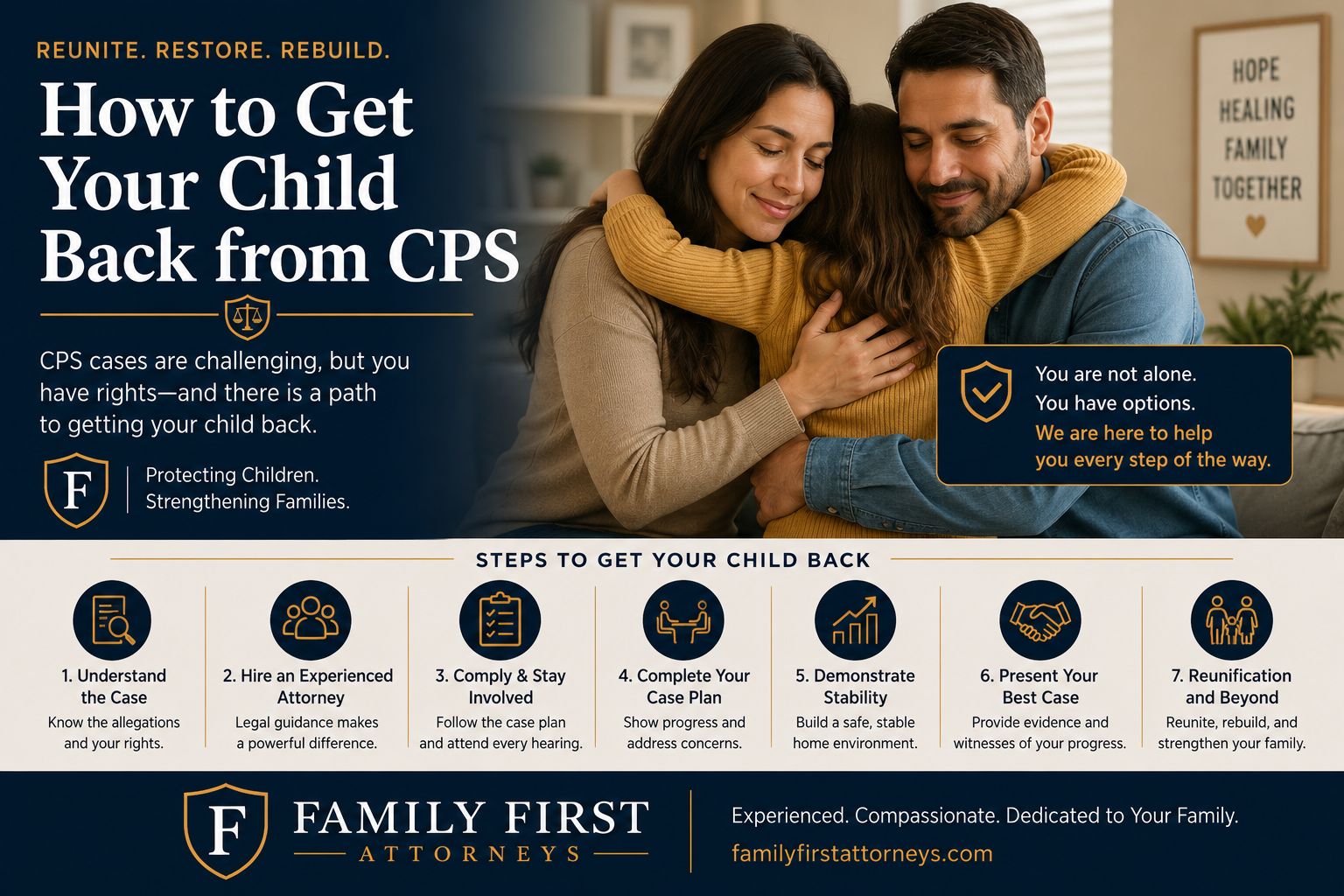
There is nothing more terrifying for a parent than the moment Child Protective Services (CPS) or the Department of Children and Family Services (DCFS) knocks on your door and removes your child from your home. The fear, confusion, and overwhelming sense of helplessness can be paralyzing. You are likely wondering where your child is, if they are safe, and most importantly, how you can get your child back from CPS as quickly as possible.
If you are reading this, you are probably in the middle of a nightmare. But it is crucial to remember that you have rights, and there is a legal process designed to reunite families. The road ahead may seem daunting, but with the right knowledge, preparation, and aggressive legal representation, reunification in California is a highly achievable goal.
This comprehensive, step-by-step guide will walk you through the actions you need to take, the court hearings you will face, and the strategies you must employ to ensure CPS returns your child to your loving arms.
Why Did CPS Take My Child? Understanding WIC Section 300
In California, CPS cannot simply take your child without cause. Under the California Welfare and Institutions Code (WIC) Section 300, a child may become a dependent of the juvenile court if they have suffered, or are at substantial risk of suffering, serious physical harm, emotional damage, or sexual abuse.
CPS investigators are legally required to assess whether your child is in immediate danger. If they believe that leaving the child in your care poses a severe and imminent threat to their health or safety, they have the authority to remove the child temporarily. Common reasons for removal under WIC 300 include:
- Allegations of severe neglect or failure to provide adequate food, clothing, or shelter
- Physical abuse or unexplained injuries
- Domestic violence occurring in the home in the presence of the child
- Parental substance abuse that significantly impairs your ability to provide adequate care
- Severe mental health crises that leave a parent unable to protect the child
Understanding the specific allegations against you is the first and most critical step in fighting back. You cannot effectively defend yourself or work toward reunification if you do not know exactly what CPS is accusing you of doing.
What Are Your Rights During a CPS Investigation?
When CPS is involved, many parents feel like they have lost all their rights. This is simply not true. You have constitutional protections that apply even during a child welfare investigation.
First, you have the right to know the allegations against you. You have the right to refuse entry to a social worker unless they have a court order, a warrant, or there are "exigent circumstances" (an immediate, life-threatening emergency). You also have the right to remain silent. Anything you say to a CPS investigator can be used against you in dependency court or even in criminal court.
Most importantly, you have the right to legal counsel. Before you sign any documents, agree to any safety plans, or make any statements to a social worker, you should consult with an experienced CPS defense attorney.
What Happens After CPS Removes Your Child?
Once your child is removed, the clock starts ticking, and the California juvenile dependency court process begins. It is a fast-paced and highly complex system. Missing a deadline or failing to understand the purpose of a hearing can severely impact your chances of getting your child back.
What Is the Initial Detention Hearing?
By law, if CPS removes your child, a Detention Hearing must be held within 48 hours (excluding weekends and holidays). This is your first opportunity to appear before a juvenile court judge. At this hearing, the judge will decide whether your child should remain in CPS custody or be returned to you while the investigation continues.
The judge will review the social worker's initial report and determine if there is a legally sufficient case that your child is at risk. If the judge decides to keep your child in custody, they will also make orders regarding visitation and where your child will stay. You should immediately advocate for your child to be placed with a trusted relative rather than in a stranger's foster home.
What Is the Jurisdiction Hearing?
If your child is not returned at the Detention Hearing, the next step is the Jurisdiction Hearing, usually held within 15 days. This is essentially a trial where the judge determines whether the allegations made by CPS are legally true.
CPS must prove by a "preponderance of the evidence" that your child falls under WIC Section 300. You have the right to contest these allegations, present your own evidence, and cross-examine the social worker and other witnesses. If the judge finds the allegations are not true, the case is dismissed, and CPS must return your child immediately. If the judge finds the allegations are true, the court takes "jurisdiction" over your child.
What Is the Disposition Hearing?
If the court takes jurisdiction, the Disposition Hearing immediately follows. This is where the judge decides where your child will live long-term and what you must do to get them back. In most cases, the judge will order a Family Reunification Plan. This is a customized set of requirements you must complete to prove that your home is safe for your child's return.
How Can I Get My Child Back from CPS?
The ultimate goal of the California juvenile dependency system is family preservation. Unless there are extreme circumstances, the court's primary objective is to reunite you with your child.
What Is Family Reunification in California?
Family reunification in California is a court-ordered process that provides parents with services and support to address the specific issues that led to the child's removal. The court will order a case plan tailored to your family's unique needs.
Your reunification plan may include mandatory requirements such as:
- Completing approved parenting classes
- Attending individual counseling or family therapy
- Participating in substance abuse treatment programs
- Submitting to random drug and alcohol testing
- Completing a 52-week domestic violence program
- Securing safe, clean, and stable housing
- Maintaining consistent and appropriate visitation with your child
What Steps Must I Take for CPS to Return My Child?
To get your child back from CPS, you must treat your reunification plan like it is the most important job you have ever had.
- Follow the Plan Exactly: Do not argue with the requirements. Complete every class, attend every therapy session, and take every drug test without complaint.
- Communicate with Your Social Worker: Keep your social worker informed of your progress. Provide them with certificates of completion and attendance sheets.
- Never Miss a Visit: Visitation is the single most critical factor in reunification. It shows the court that you are deeply bonded with your child and committed to being in their life.
- Stay Out of Trouble: Avoid any new arrests, domestic disputes, or drug use. Any new issues will give CPS ammunition to argue that you are not ready to have your child back.
- Build a Support System: Show the court that you have a network of family or friends who can help you safely parent your child.
- If your child was under 3 years old at the time of removal: You generally have only 6 months to make significant progress on your case plan. Because young children need permanency quickly, the court moves fast. If you fail to make progress, the court can terminate reunification services at the 6-month mark.
- If your child was 3 years or older at the time of removal: You typically have 12 months to complete your plan and get your child back.
How Long Does CPS Keep a Child?
One of the most common and heartbreaking questions terrified parents ask is, "How long does CPS keep a child?" The answer depends heavily on the age of your child at the time of removal and your personal progress with the reunification plan.
In California, the law sets strict timelines for reunification services:
In some cases, if you can show that you have made substantial progress, the judge may extend services up to 18 months, or in very rare cases, 24 months. However, you should never rely on getting an extension. Time is your biggest enemy in a CPS case, and you must act with absolute urgency from day one.
Frequently Asked Questions About CPS and Child Removal
Can CPS take my child without a warrant?
Yes, but only under specific, limited circumstances. CPS can remove your child without a warrant if they have reasonable cause to believe the child is in immediate danger of severe physical harm or sexual abuse, and there is no time to get a court order. In all other situations, they must obtain a warrant from a judge before removing your child from your custody.
Do I have to let CPS into my home?
No. The Fourth Amendment protects you from unreasonable searches and seizures. Unless the social worker has a warrant, or there are exigent circumstances, you do not have to let them into your house. However, refusing entry may prompt them to return with law enforcement and a warrant. It is always best to consult with an attorney before allowing CPS into your home.
What if the allegations against me are completely false?
False allegations are unfortunately common, often arising during bitter custody disputes or from vindictive neighbors. If the allegations are false, you will have the opportunity to prove this at the Jurisdiction Hearing. Your attorney will help you gather evidence and cross-examine the accuser to expose the truth.
Can my child be placed with a relative instead of foster care?
Yes. California law strongly prefers placing children with relatives or extended family members rather than strangers in foster care. You should immediately provide the social worker with a list of willing and able relatives who can care for your child while you work on your reunification plan.
Will I get to visit my child while they are in CPS custody?
In almost all cases, yes. The court recognizes the critical importance of maintaining the parent-child bond. Unless visitation would be actively detrimental to the child, the judge will order regular visitation. These visits may be supervised initially, but as you progress in your case plan, they can transition to unsupervised visits and eventually a full return home.
Do I need a lawyer to get my child back from CPS?
Absolutely. The stakes could not be higher—you are fighting for the fundamental right to raise your own child. The dependency court system is adversarial, and the county has a team of lawyers fighting against you. Having a skilled, aggressive attorney who understands California family law and CPS defense is your absolute best chance at bringing your child home safely and quickly.
Contact Family First Attorneys in Orange, CA
If CPS has removed your child, or if you are currently under investigation by DCFS, every single second counts. You cannot afford to wait, and you cannot afford to fight this battle alone. The system is designed to move quickly, and without aggressive legal representation, you risk losing your parental rights forever.
At Family First Attorneys, located in Orange, California, Managing Attorney Mitchell Krems and our dedicated legal team understand exactly what you are going through. We have extensive experience defending parents against CPS and DCFS, and we know how to navigate the complex California juvenile dependency courts. We will stand by your side, protect your constitutional rights, and fight tirelessly to ensure CPS returns your child where they belong—with you.
Do not let the system tear your family apart. Contact Family First Attorneys today to schedule a confidential consultation and take the first critical step toward getting your child back.
Protect Your Family — Call Now
If CPS or DCFS is involved with your family, don't wait. Family First Attorneys provides 24/7 emergency consultations and aggressive defense for parents across Los Angeles, Orange, Riverside, and San Bernardino Counties.
Call (468) 777-7777 — Free ConsultationThis article is for informational purposes only and does not constitute legal advice. No attorney-client relationship is formed by reading this content. Every CPS and DCFS case is unique and the outcome depends on the specific facts and circumstances involved. Please consult a qualified California family law attorney regarding your specific situation.